Weight loss is simple but it is not easy. There are many things that you have to do in order to be successful at it. There are things to change before you begin.
This guide has everything you need to begin your weight loss journey. It will be broken up in to two parts.
Part one will deal with changing your mindset and changing your environment so you will have a better chance to succeed.
Part two will deal with the nuts and bolts of nutrition and meal planning.
If you follow this guide and answer all of the questions that I ask, your mind will be in the right place to begin this journey to simple, sane, and sustainable weight loss. Get a pad of paper and a pen and let’s begin.
Part 1: Mindset
STEP ONE: Getting Your Mind in the Right Place
Before you start anything new, you have to know why you are doing it. You might have many reasons why you want to lose weight. Get out your pad and paper and write down what goals you wish to accomplish. Do not try to rank them- just write them down. Once you have written them down, rank them in order of importance.
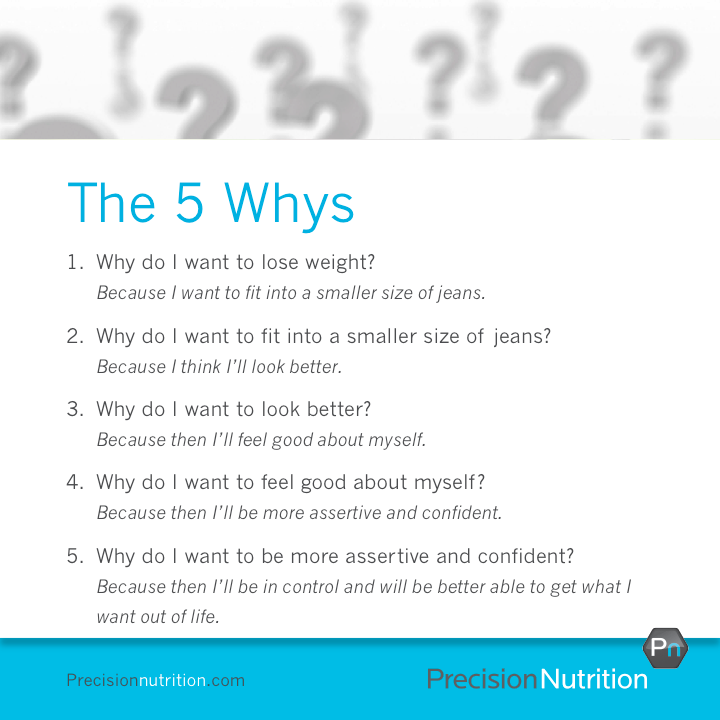
For your top goal, you will do an exercise called the Five Whys. The purpose of this is to get to the root cause of why you want your goal. For each goal, you ask yourself why you want that goal and you ask it for each answer till you have answered it five times. The purpose of doing the 5 Whys is to align your goals with your values.
Part 2: Environment
Once you have your goals in mind and why you want them, it is time to work on your environment.
Dr. John Berardi, co-founder of Precision Nutrition, is quoted as saying “If a food is in your possession or located in your residence, either you, someone you love, or someone you marginally tolerate, will eventually eat it.” Basically, he is saying that if you have it, you will eat it.
While no foods are off limits, you want to make sure that the most healthy foods are easily available to you and less healthy foods are less easily available. To do this, you will first need to do a kitchen makeover.
The first step is to look at all of the food that you have in your house. Clear out your pantry, your refrigerator, your freezer, and any place else where you hide food. Throw out anything that is expired or otherwise no longer useable. Once you have done this, you will need to decide what to do with what is left.
Foods are often classified according to nutrition density. Nutrient density has been defined as the ratio of beneficial ingredients as compared to the number of calories in a typical serving of the food. Beneficial ingredients are things such as vitamins, minerals, fiber, calcium, and iron. Nutrients that are not as beneficial include saturated fats, added sugar, and salt.
All foods will fall in one of the following categories:
- It will be highly nutritious and low in calories. Examples are fruits like strawberries, apples, and melons, non-starchy vegetables like lettuce, spinach, most fish, lean cuts of meats, beans, and lentils. Most of your diet should come from these foods.
- It will be highly nutritious but high in calories. Examples from this group are avocado, dates, nuts, nut butters, starchy vegetables like white potatoes and sweet potatoes, and olive oil. These should be included sparingly.
- It will be low calorie and not very nutritious.
- It will be high calorie and not very nutritious.The foods in groups 3 and 4 are often considered to be empty calorie foods such as highly processed foods and they should be avoided.
The chart below summarizes the 4 categories of foods.
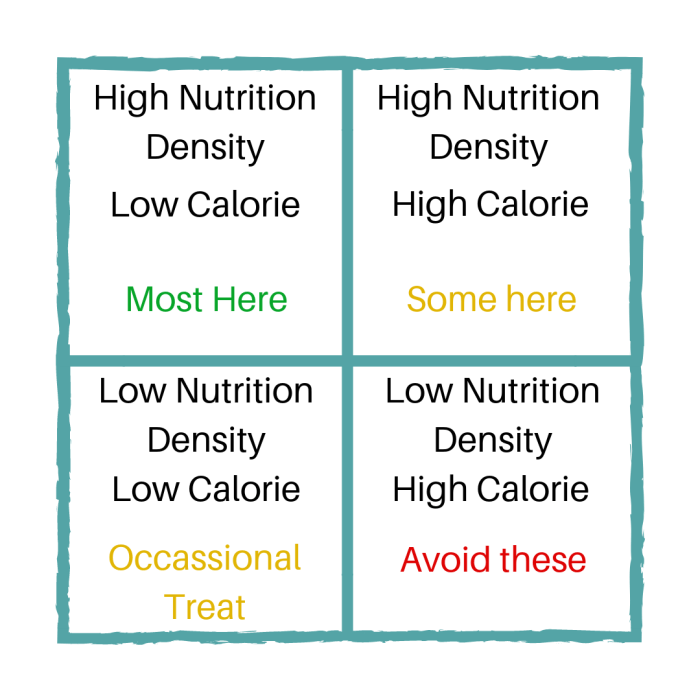
For each food that you have decided to keep, you need to decide where it falls on the above chart. The bulk of your diet should come from highly nutritious, low calorie foods. You want to keep these where you can reach them easily. For example, you would want to keep your fruits and vegetables in a part of the refrigerator that is easily accessible or in a fruit bowl on the table.
The next group, the highly nutritious, high calorie foods should be harder to get to. Keep them in the back of the pantry or refrigerator.
The low nutrition-low calorie foods should be kept to a minimum as an occasional treat and you want to avoid foods that are high in calories and low in nutrition.
Once you have your food put away, it is time to organize your cooking implements. You want to have everything that you need to be able to prepare your meals and store them.
This is a short list of essentials that I like to have on hand and recommend you purchase if you do not already have them.
- Knives
- Cutting board
- Set of pots and pans
- Measuring cups for dry goods
- Measuring cup for liquids
- Measuring spoons
- mixing bowls
- Food scale that measures in both ounces and grams
- Food storage containers
- Crock Pot or InstaPot (Optional but nice to have)
- Blender
This list is by no means exhaustive. Get anything that you feel would be useful in helping you prepare and store healthy foods.
After you have gotten your kitchen in order, it is time to make your grocery list and go shopping. I will talk more about this in Part 2.
 RSS Nutrition and Fitness